The Corvée
The Corvée — Faction Bible (working title)
The generational unpaid labour who toil in the sprawling Agfields south of Megacity One.
Symbol & Logo
A bound sheaf — grain gathered and tied, the cord marked with hatch-tallies like days owed. Stippled woodcut white-on-black. Not a battle-flag. The mark of a people counted in work.
They do not join the Corvée. They are it, the way a body is Gen Pop once the implant takes. The sheaf is what the field is for. The notches are what a life is for.
Status: logo established.
Names
The Corvée is the obligation: unpaid labor for the lord, a tax paid in days. You work your own ground to live. You work his because he owns you. The ministries print it. The keeps enforce it. Their own mouths are shorter — the tagged, day-folk, serfs. The stacks, when they bother, say furrow and yield-serfs.
Overview
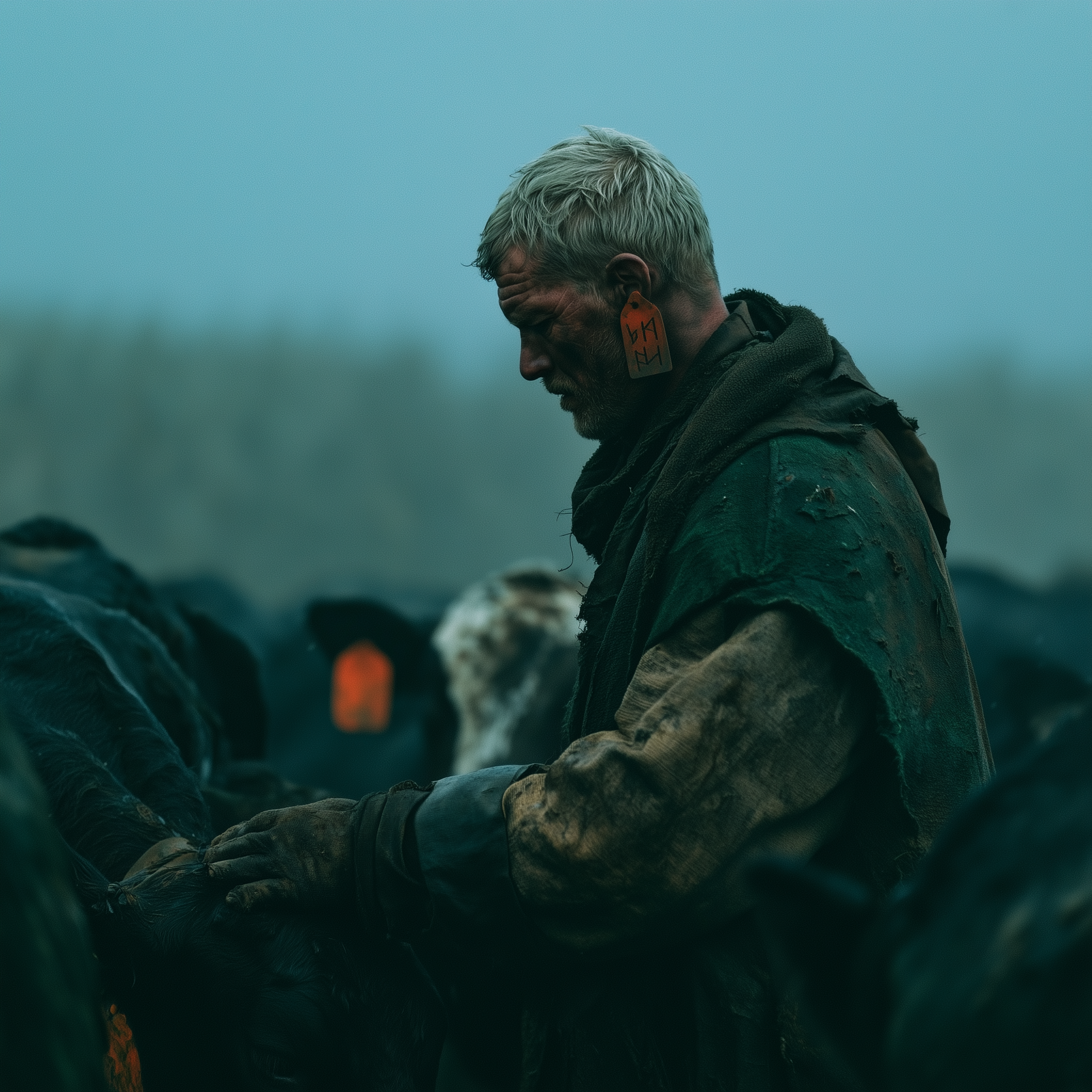
The Agfields are endless pastoral farmland south of the hive. The people who live in them are not free riders like the Solari Clans and not counted citizens like Gen Pop. They are serfs. Each is an entry on a banal roll — which keep owns them, which land they work, how many days they must give. That entry is not kept on paper alone: it is punched into the ear as a coloured plastic tag, the same clip a farmer snaps into livestock.
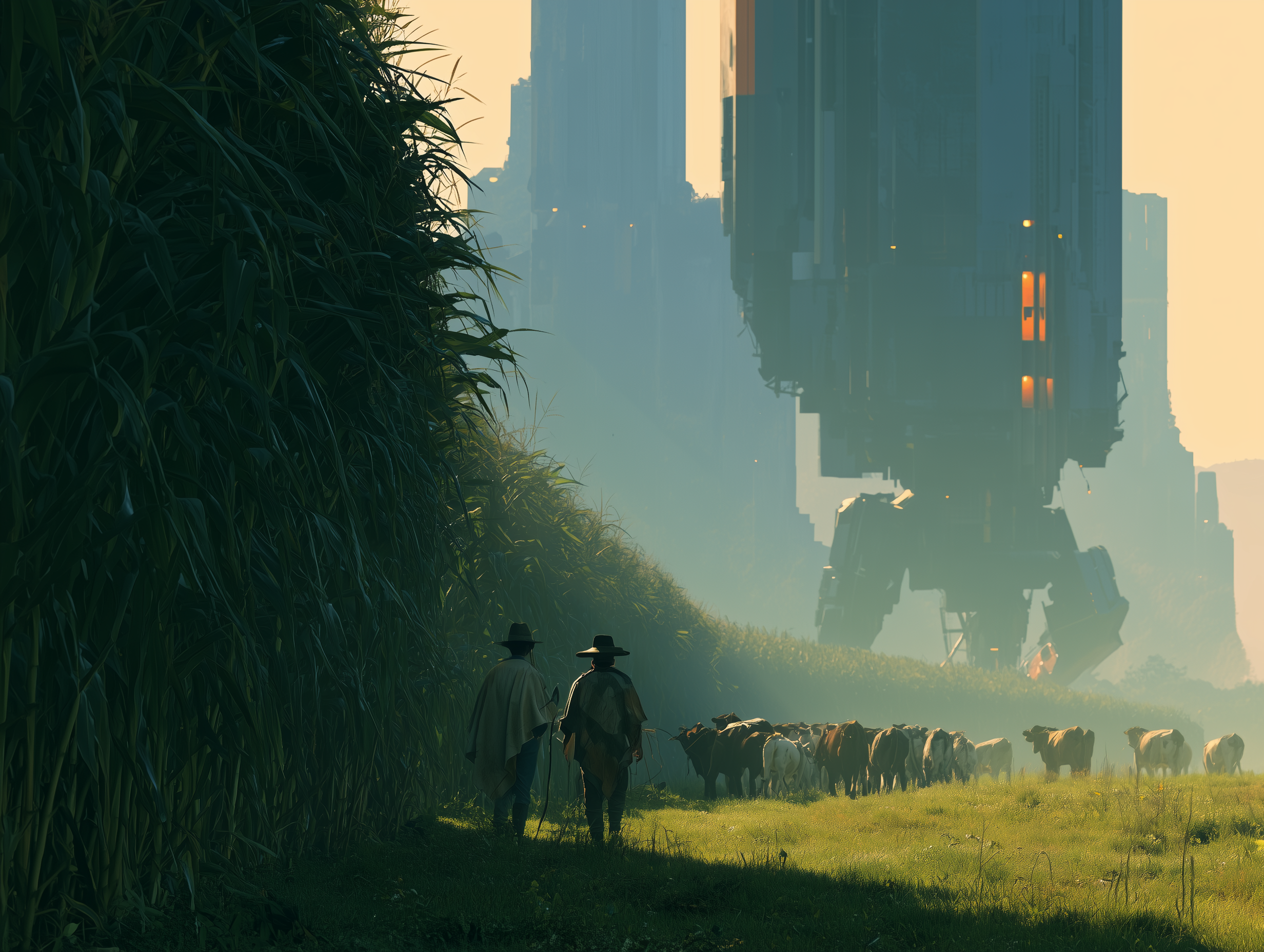
The giant harvesting bots do the work of a hundred labourers. The Corvée do what the machines do not bother with — weeding, ditching, loading, the ugly edges — and the theatre of being called, lined, made to wait in the lane while a combine walks past. When a Banal Lord is angry, the days go up. When he wants to feel like a real noble, the levy is the point.
Life in the Fields
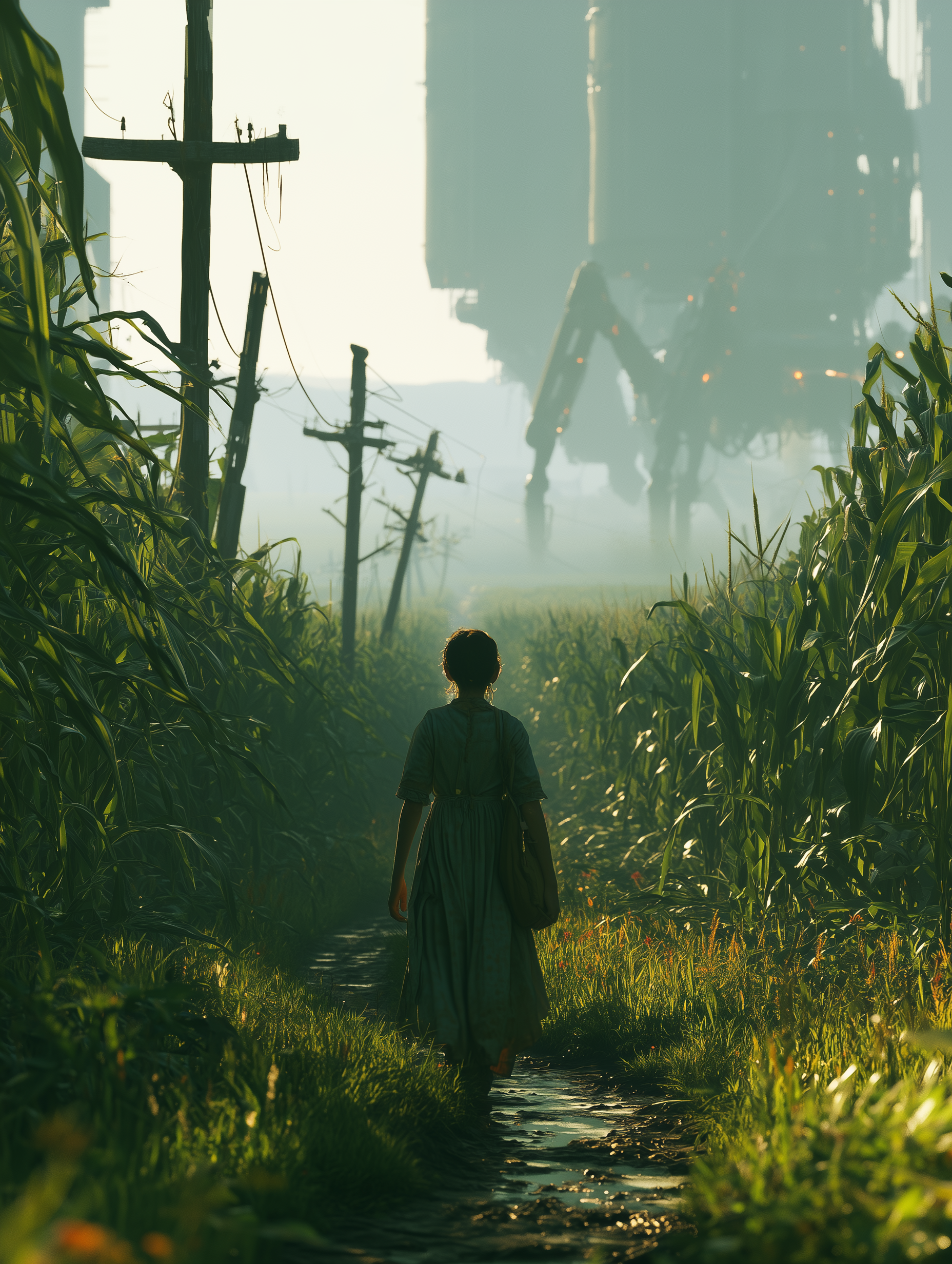
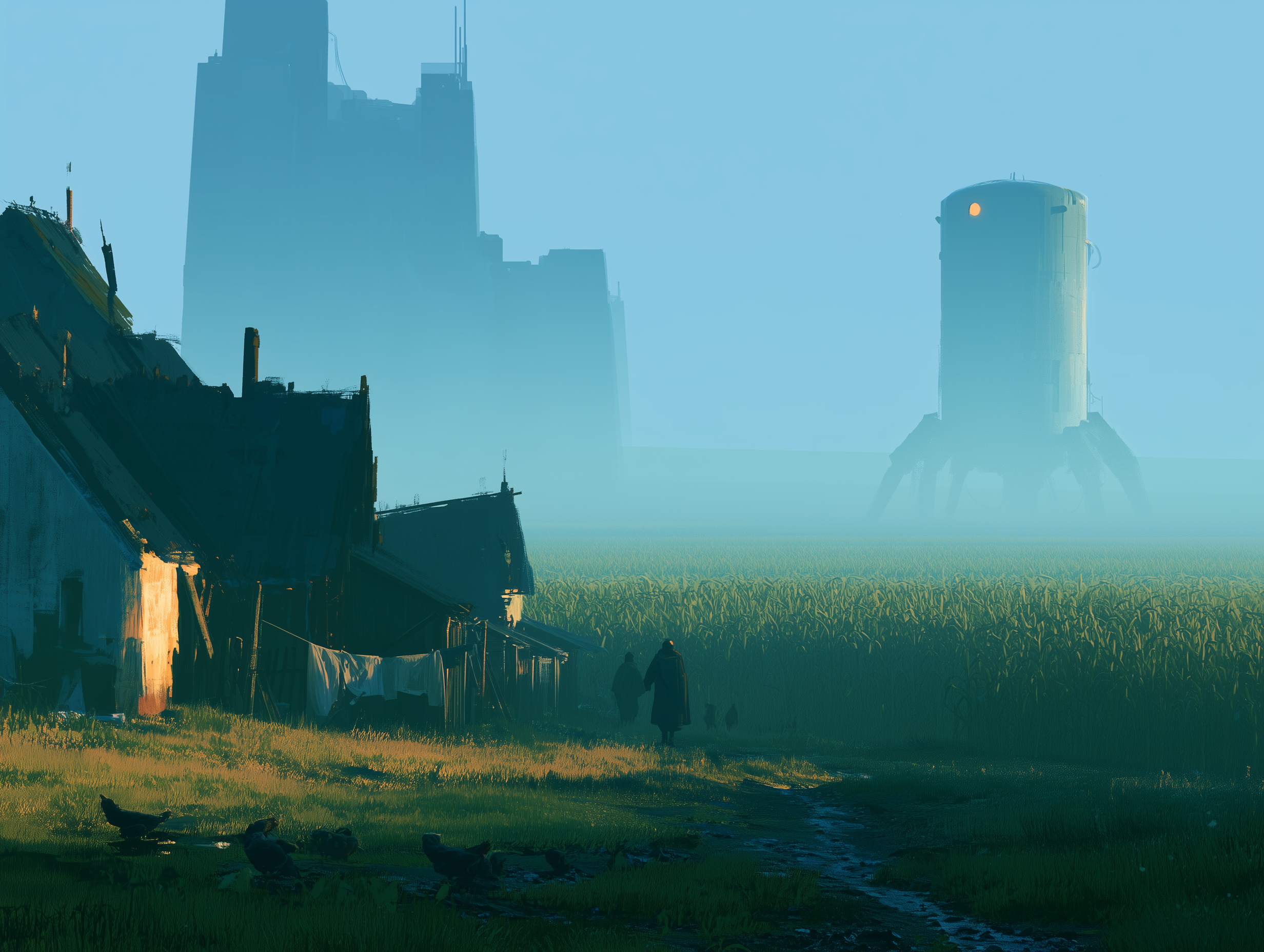
Mud paths. Corn as architecture. Peasant cloth. Satchels. Leaning poles that are their grid, neglected, half-dead. The lord’s grid is the walking mill in the fog — lit, summoned, not theirs. Scale is class. They live at path height. Power lives in the weather layer.
They are not an army. They are the rural mass: hedgerow towns, bonded households, a people the city pretends is not a people. Most keep their heads down. Some hide a Partisan on a Sunday and curse one on a weekday, after the sluice is shut in answer.
The Tag
Every Corvée wears one: a tab of coloured plastic punched through the ear, the same clip a farmer snaps into a calf. There is a practical excuse — the Agfields are vast and rural, the watch-towers stand too far apart and rot untended, and a subcutaneous chip is a poor thing to verify across ground that runs to the horizon. But the excuse is only half of it. The lords could have chipped the Corvée quietly. They chose the ear — to mark a person the way you mark livestock, plainly, for their own egos. Each sector keeps its own colour; that is the only thing that changes from field to field. The tag itself never does.
Relation to Other Factions
- The Banal Lords: The keep. The ban. The weather of the week.
- The Partisans: Volunteers from among them. Kin and danger. Sabotage is answered on the Corvée, not on the cell.
- The Regime: Eats the yield. Does not learn their names.
- Gen Pop: Cousins in the stacks who think bread arrives. The Corvée know it is walked there.
- The Steppe Nomads: The other grassland people — free, north of the hive, untagged. A contrast, not a kinship the Corvée can use.
- The Druids: The forest to the east. Not friends. A door the Partisans knock on when they need weapons the fields cannot make.
The Circle
The Druid forests border the Agfields to the east, and once in a while — never in daylight, never near a walker — a village opens the corn to them. The Partisans are the ones who ask. The Druids are the ones who supply: precision rifles, cutting charges, drone hulls the keeps would kill a hamlet for owning. Both sides call the meeting the Circle.
The exchange is done in a clearing pressed flat by hand, in the dark, with a torch or two and the pack of iron wolves watching from the rim. A cybernetic ox comes out of the treeline with the crates. An antlered druid meets the envoy. Nobody speaks louder than they have to.
The price is a bride — once a season, a young adult woman handed over to the forest in exchange for what the crates carry. The village does the delivering. The woman screams. The druid beckons the crates in behind him without looking. It is a trade the Corvée accept because the Partisans need what is inside those crates; and the bride pays for the crates because no one asked her.
The Druids only ask for one kind of bride. They ask for the girls who dream true — the same latent gift the Regime’s Jesuits search out and raise in the hive to serve the Oracle. In the fields the gift is not honoured. A Corvée girl who dreams what has not happened yet is a curse on a hamlet with no priest to explain her. The Banal Lords cannot use a precog even if they wanted one; the keeps are denied Jesuits, denied the Oracle’s sight, and there is no seat in a provincial court for a girl who knows the harvest before it comes in. So a girl the fields would rather be rid of becomes the currency of the trade. Everyone at the clearing knows what has been paid. Nobody says it.
Aesthetic
Wool and mud. Paths through crop-walls. Fog. A machine too large to be a tool. No crests. No chrome — only the cheap coloured tag in the ear, the one mark a person cannot take off.
Mood
Plenty that does not feel free. Horizon without wildness. A life at path scale.
Open Threads (to expand)
- How does one become corvée — birth in the fields, a debt, a sentence from the hive, a roll that cannot be left?
- When is the tag first punched in — at birth, at first labour, at the moment the roll claims you?
- Can the Corvée ever climb into Gen Pop, or is the membrane one-way, like the Spill in reverse?
- Who keeps the rolls — the keep, a ministry clerk, a literate caste in the hedgerows?
- Do the bots still need them, or is the corvée now mostly for proving the lord still has people?